


Enterprise Data Infrastructure & Gated Workflow Management
A unified extranet for complex humanitarian and development datasets
Expertise
 Web applications
Client
Southeast Asian humanitarian information unit
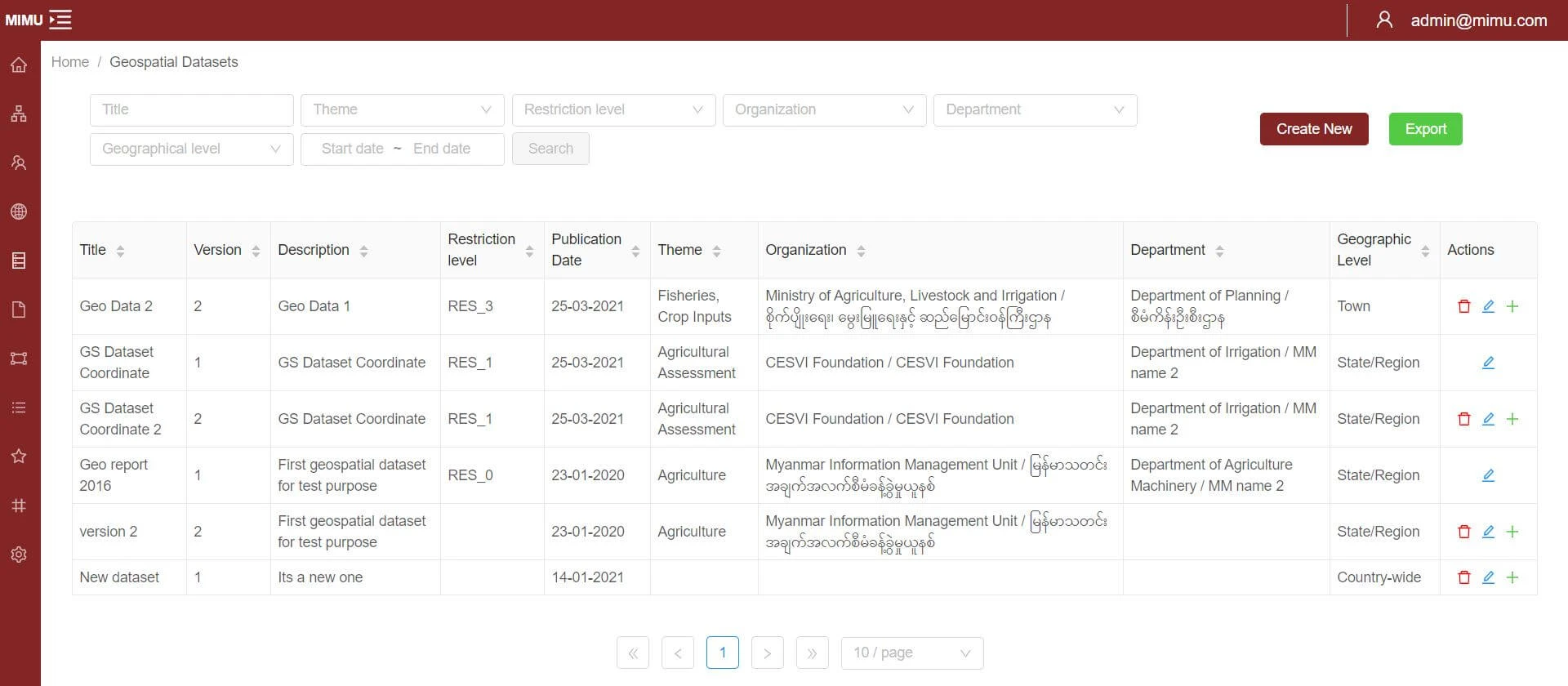
A humanitarian information-management unit is a central information resource for humanitarian, development and peace-focused activities in Southeast Asia. It collects, standardizes and organizes administrative, organizational, geographic and spatial datasets used by international agencies, NGOs and government stakeholders.
Outsourcify engineered a secure custom extranet that consolidates these fragmented datasets behind one guided interface. Non-technical operators can search, create, validate and maintain deeply related records without working directly in PostgreSQL, while the application protects the integrity, permissions and history of the underlying data model.
Results
Challenge
The organization's information ecosystem had grown into a highly relational architecture distributed across specialized datasets. Turning that structure into a safe operational tool required solving several connected problems:
- Relational complexity: more than 150 cross-referenced tables made direct administration slow and vulnerable to foreign-key and consistency errors.
- Entry friction: non-technical staff needed to create multi-level one-to-many records without understanding the underlying schema.
- Data-quality pressure: imports from multiple organizations required consistent formats, business rules and validation before entering production datasets.
- Functional diversity: baseline indicators, GIS resources, web services, events and partner requests needed separate workflows while sharing a common data foundation.
- Traceability: administrators needed to know who changed a record, what changed and which previous state it replaced.
Solution
A Symfony REST backend encapsulates relational rules, permissions, validation and record history, while a Vue.js / Nuxt.js frontend turns the data model into guided workflows. More than 25 complex forms and hundreds of focused CRUD views let users add nested child records in context, without reloading or exposing raw database structures. Import processes check CSV and Excel files against schema and business rules before accepted records reach PostgreSQL. Dedicated modules organize baseline indicators, spatial resources, web services, events and requests, while application- level roles, session policies and versioned audit history protect the system throughout its operational lifecycle.
Tools
Symfony, Vue.js / Nuxt.js, PostgreSQL, REST APIs, CSV and Excel import validation
Team
1 Project Manager, 1 Project Coordinator, 1 Front-End Developer, 1 Symfony Developer
Methodology
Agile delivery with requirement traceability and documented SOPs
Tools
Symfony, Vue.js / Nuxt.js, PostgreSQL, REST APIs, CSV and Excel import validation
Timeframe
6 months
Team members involved

From relational complexity to guided data entry
The interface replaces direct database work with task-oriented forms. Operators can:
- search, create and edit records through familiar business terminology;
- add multiple levels of related child data inside a parent workflow;
- apply business rules that affect several connected objects;
- validate imports and exports before committing data;
- review version history and trigger operational notifications.
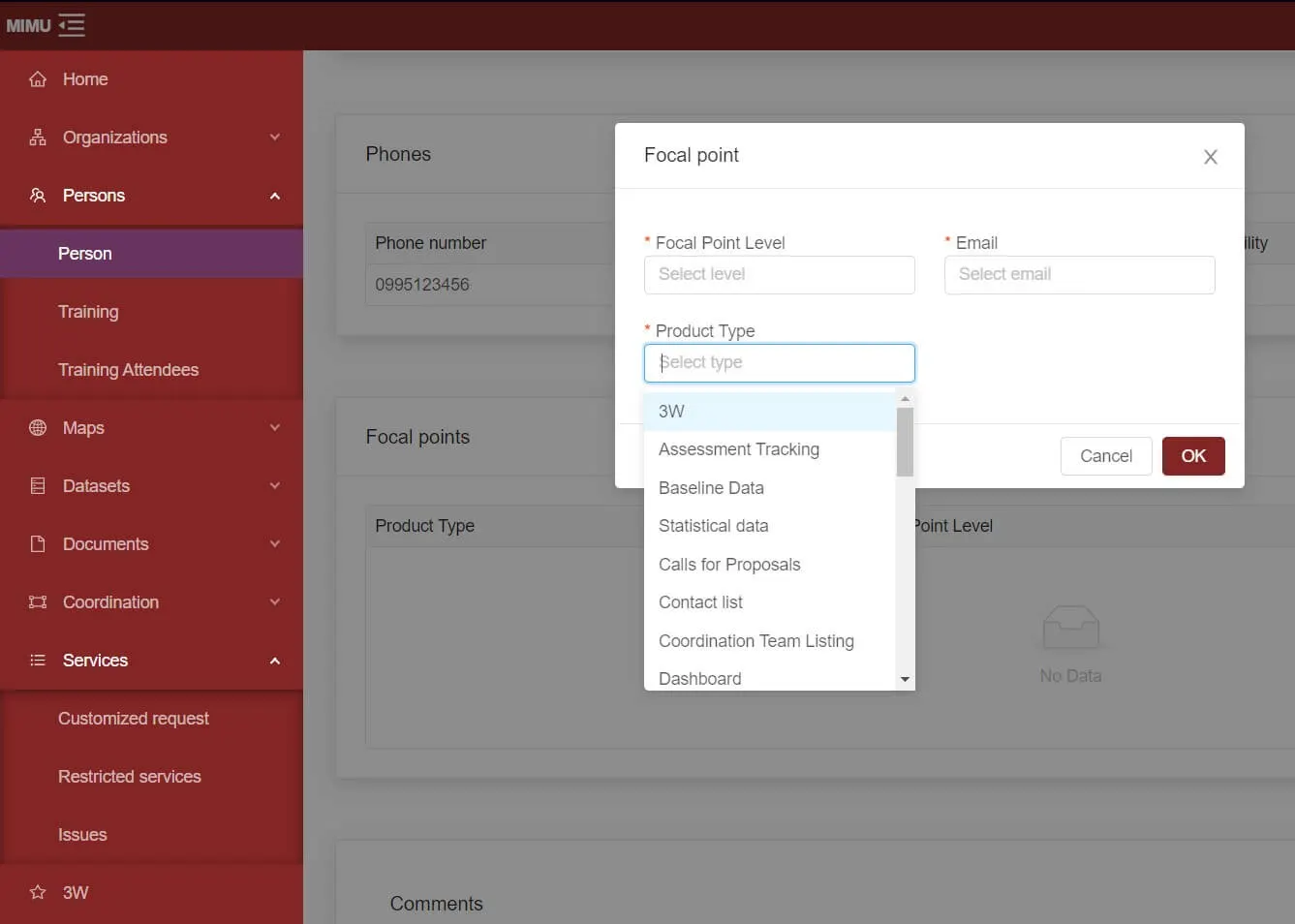
Dedicated modules on one shared data foundation
Data & baseline indicators
- Countrywide statistical indicators.
- Administrative and departmental classifications.
- Structured partner and organizational records.
GIS & spatial coordination
- Geospatial dataset cataloguing.
- Map-series and distribution tracking.
- Partner requests for specialized spatial resources.
Web services & events
- Restricted internal service workflows.
- Event and attendee information.
- Notifications and request-status coordination.
Specification-driven engineering reduced ambiguity
The organization provided a detailed logical data model and documented Standard Operating Procedures before implementation. Inputs, validation paths, permissions and expected error states could therefore be traced from a requirement to a form, API rule and acceptance check. For a system with hundreds of relationships, that documentation was not administrative overhead—it was part of the technical architecture.
Validation before data reaches the live model
The platform moves quality control to the entry boundary:
- Map: incoming columns are matched to the expected schema and classifications.
- Validate: formatting, required fields, relationships and business rules are checked.
- Review: operators see actionable errors instead of raw database failures.
- Commit: only accepted records are written to the production data model.
- Trace: subsequent edits create a history that administrators can review later.
Operational trust built into the application layer
Access control
- Token-based authentication.
- Granular application roles.
- Strong password requirements and annual credential rotation.
Session safety
- Automatic timeout after 60 minutes of inactivity.
- Restricted access to operational modules.
- Clear separation between users and administrative functions.
Historical accountability
- User actions recorded in audit history.
- Versioned changes instead of blind overwrites.
- Previous record states available for investigation.
Beyond direct database administration
| Capability | Direct database tooling | Guided application model |
|---|---|---|
| Relational entry | Manual row editing and database knowledge | Guided nested forms preserve relationships |
| Data quality | Errors discovered after insertion | Preflight checks block invalid records |
| History | External logs or manual documentation | Native version and user-action history |
| Permissions | Broad database-level access | Granular roles at workflow and module level |
| Usability | Designed for database specialists | Business-language interface for operational staff |
Where this project sits in our history
- 2019
 Fortify Rights (Singapore)NGO UX/UI and Wordpress website
 - 2020
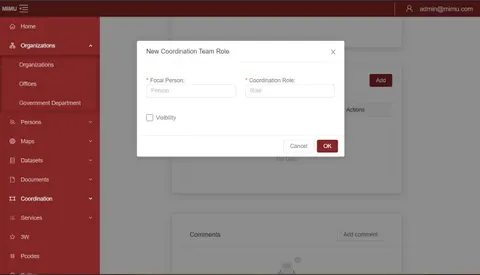 Southeast Asian humanitarian information unitEnterprise Data Infrastructure & Gated Workflow ManagementYou are here
 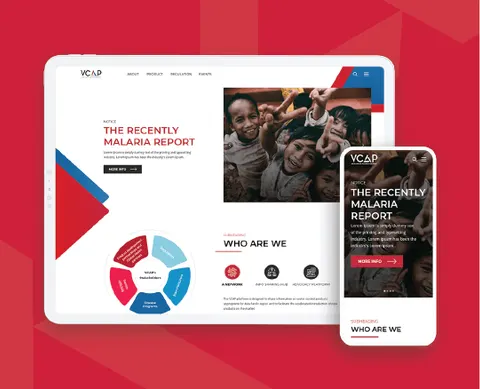 2020VCAPMalaria fighting NGO Website
- 2023
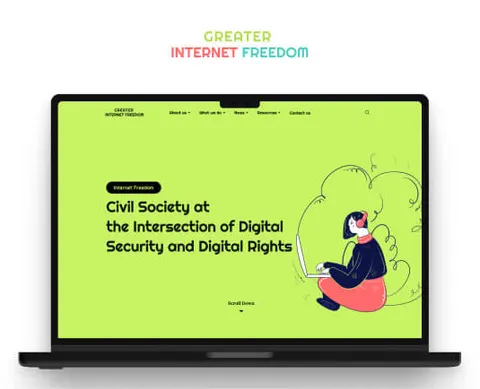 Greater Internet FreedomA Custom Wordpress Website for Greater Internet Freedom
 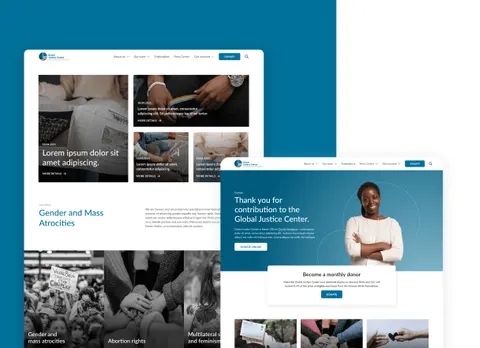 2023Global Justice CenterA redesign of this New York NGO
- 2024
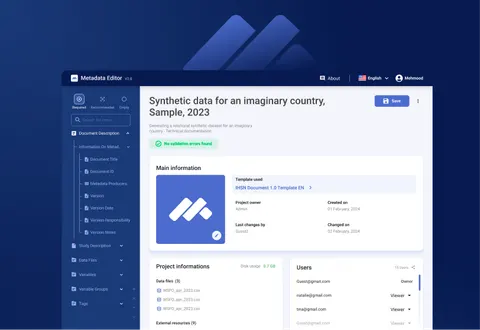 Multilateral development institutionUI/UX & Frontend for an International Metadata Editor
Contact us
Let’s find the right solution for your business.
We partner with product teams and founders to design, build, and ship software that lasts.
Talk to our team