


Flask
A lightweight Python web framework for focused APIs, integration gateways and custom backend services.
Flask gives Python teams a small, explicit foundation for web APIs without imposing a large application structure. We use it when a product needs a focused integration layer, microservice or custom backend whose dependencies and behavior should remain easy to understand.
A focused Python framework for APIs
Flask is a lightweight Python web application framework. It supplies routing, request handling and a clear extension model while leaving database, authentication and background-processing choices to the engineering team.
That makes Flask a strong fit when the backend has a precise responsibility:
- API gateways between mobile apps and existing business systems
- REST or JSON APIs for Vue, Nuxt, React or Flutter clients
- integration services that validate and transform third-party data
- compact internal tools and administrative services
- microservices that should remain independently deployable
Production proof: a university super-app
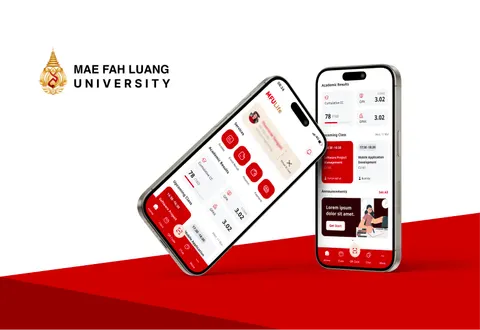
For the Mae Fah Luang University super-app, we built a Flask API gateway between a Flutter mobile application, the university’s central MIS and SSO services, and a headless WordPress administration portal. The gateway sanitizes and routes traffic for schedules, examination data, grades, payments, announcements and four distinct user profiles.
This is the kind of role where Flask is particularly useful: the service stays focused while the wider product can combine the most suitable systems for mobile delivery, content management and institutional data.
How we engineer Flask backends
We keep the framework lightweight without treating production concerns lightly. Depending on the project, a Flask service can include schema validation, role-based access, structured logging, automated tests, rate limiting, background queues, caching and containerized deployment. PostgreSQL, MySQL, MongoDB or Redis can be selected according to the data and workload rather than framework convention.
Flask also works naturally alongside our broader Python expertise, including automation, data processing and AI integrations.
When we recommend something else
Flask is not automatically the best choice for every Python application. Django can be more efficient when a project needs a complete administrative backend, ORM and authentication model from day one. For highly concurrent async workloads, an ASGI-first framework may be more appropriate. We make that decision during architecture discovery rather than forcing every backend into the same stack.
If you need a custom Python API or an integration layer between existing systems, talk to our engineering team.
This technology, year by year
From our blog & guides
Agility Isn’t Dead. It’s Finally Becoming Real
A concept we never fully adopted—until now For years, “Agile” has been one of the most overused terms in our industry. It became a label more than a reality, often reduced to rituals: sprints, stand-ups, grooming sessions, velocity tracking. The promise was speed and adaptability, but in practice, many teams ended up with structured cycles… View Article
Read more →
AI Is Reshaping Web Development — But Not in the Way People Think
Artificial intelligence is currently one of the most discussed topics in the technology industry. In web development, the dominant narrative often suggests that AI will replace developers and dramatically reduce the need for engineering teams. From what we observe in practice at Outsourcify, the reality is very different. AI is not replacing developers. Instead, it… View Article
Read more →
Will AI Replace Developers? A Reality Check From the Field
Artificial Intelligence has rapidly become the central topic of discussion in the technology industry. Every week seems to bring new announcements about AI models, AI agents, and predictions about how the technology will reshape the global economy. Some commentators claim that AI will soon replace large portions of the professional workforce, including software engineers. Others… View Article
Read more →Contact us
Let’s find the right solution for your business.
We partner with product teams and founders to design, build, and ship software that lasts.
Talk to our team