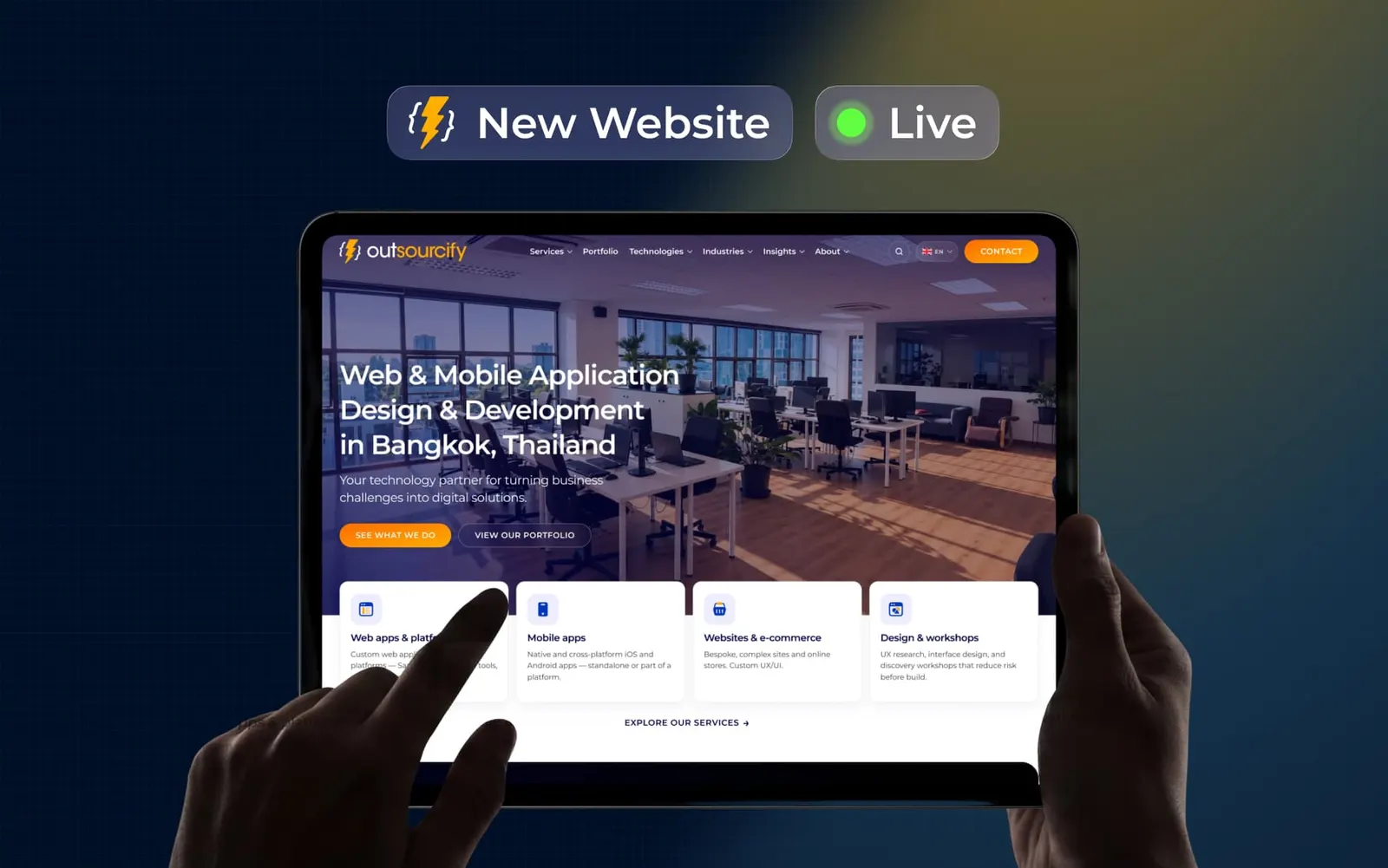
We just flipped the switch on a new outsourcify.net, and it’s the biggest change to our own site in years. Not a theme refresh — a full rebuild, from the CMS up.
Why we rebuilt it
Our old site had done its job well for a long time. It also had the thing every WordPress site accumulates after a decade of edits, plugins and one-off fixes: weight. Every new case study, every guide, every design tweak added a little more friction to the next one. We were spending more time fighting the platform than using it, and — as an agency that spends its days telling clients to keep their own web presence in shape — that started to feel backwards.
So we did what we increasingly recommend to clients in the same position: we moved off WordPress entirely and rebuilt on Astro, with content collections instead of a database, and static pages instead of a PHP request on every visit.
Same look, adapted foundations
One thing we want to be clear about: this was not a rebrand. We didn’t bring in a design agency to reinvent how Outsourcify looks online — the goal was to adapt what was already working, not transform it. Here’s the old homepage next to the new one:
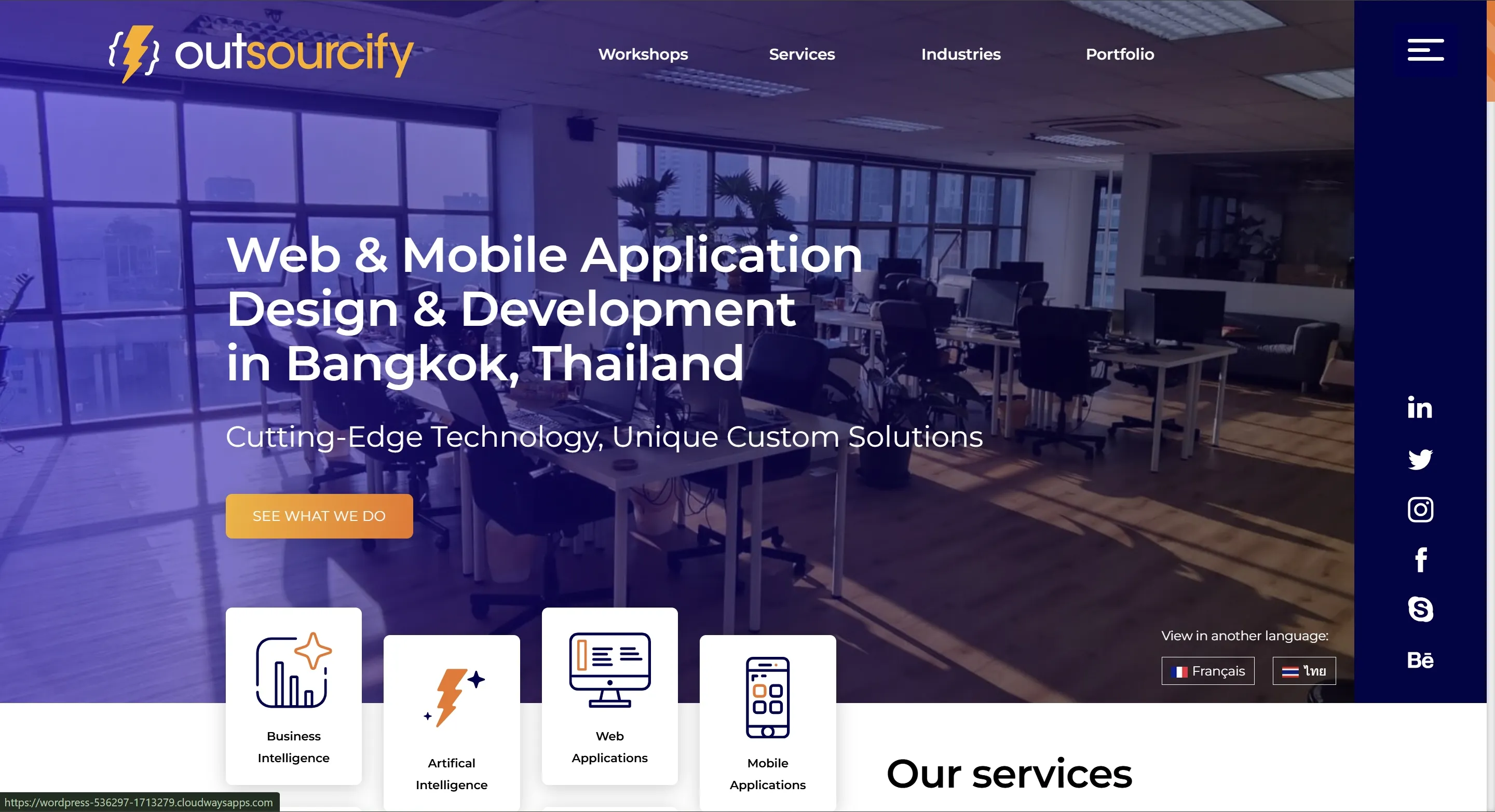
Before — the WordPress site.
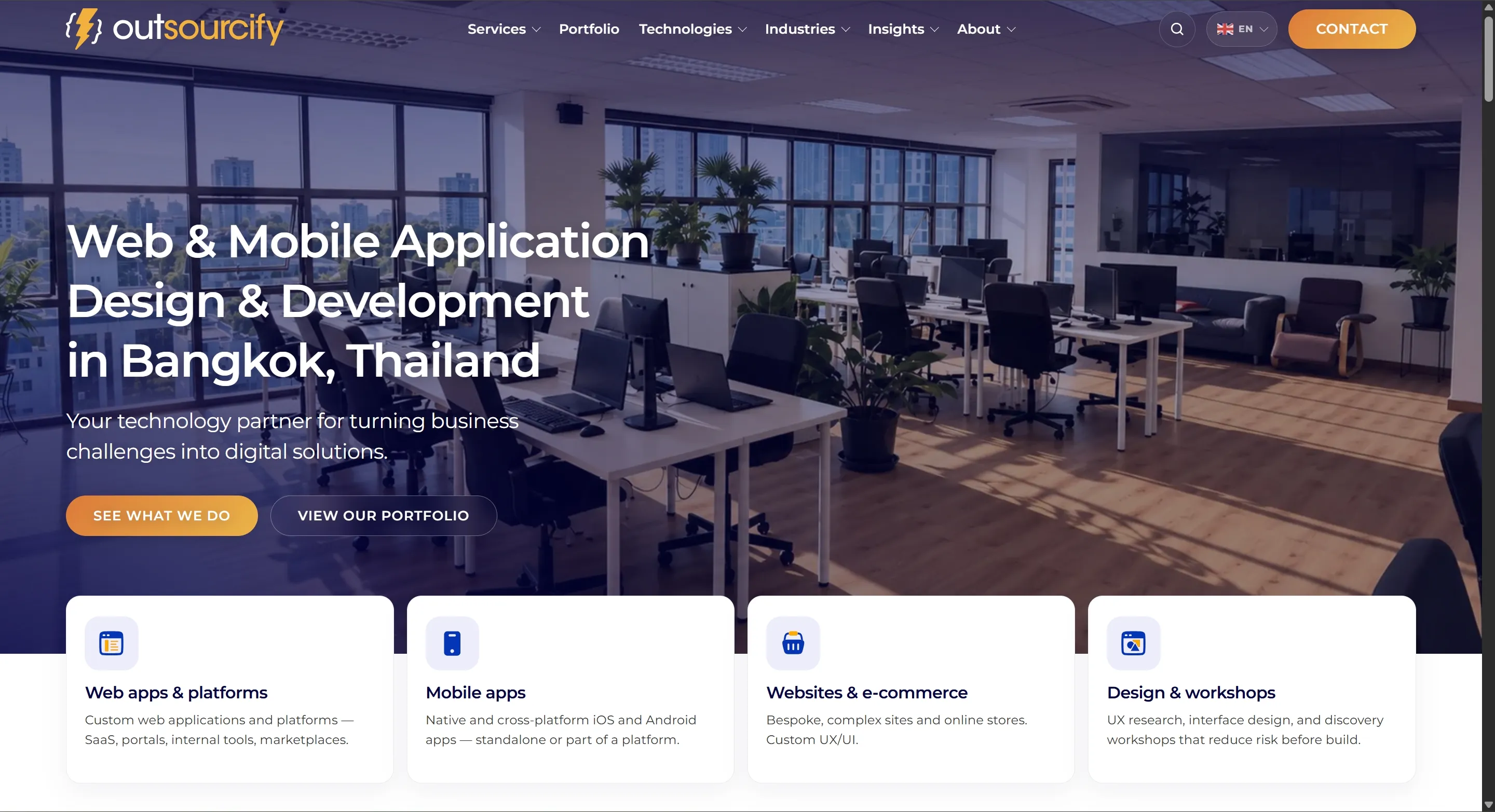
After — the same site, rebuilt on Astro.
Same navy-and-orange palette, the same photo of our own office, largely the same message. What changed is everything underneath it and around the edges — tighter layout, sharper copy, and navigation that actually reflects how the site has grown, with dedicated Technologies and Insights sections that didn’t exist before. If you’ve worked with us already, we wanted you to recognize the site immediately. We just wanted it to work better.
What’s actually different
A few things you’ll notice right away:
- It’s faster. Pages are pre-built at deploy time rather than assembled on request, so there’s no database query standing between a visitor and the page.
- It’s fully bilingual. Every one of our case studies, reviews and team profiles now has true English/Thai parity, built into the content structure rather than bolted on with a translation plugin.
- Nothing broke. We carried forward more than 860 legacy URLs as redirects, so old links, bookmarks and search results still land in the right place.
- It’s easier for us to maintain. New case studies and articles are now plain content files reviewed like code, not database rows edited through an admin screen.
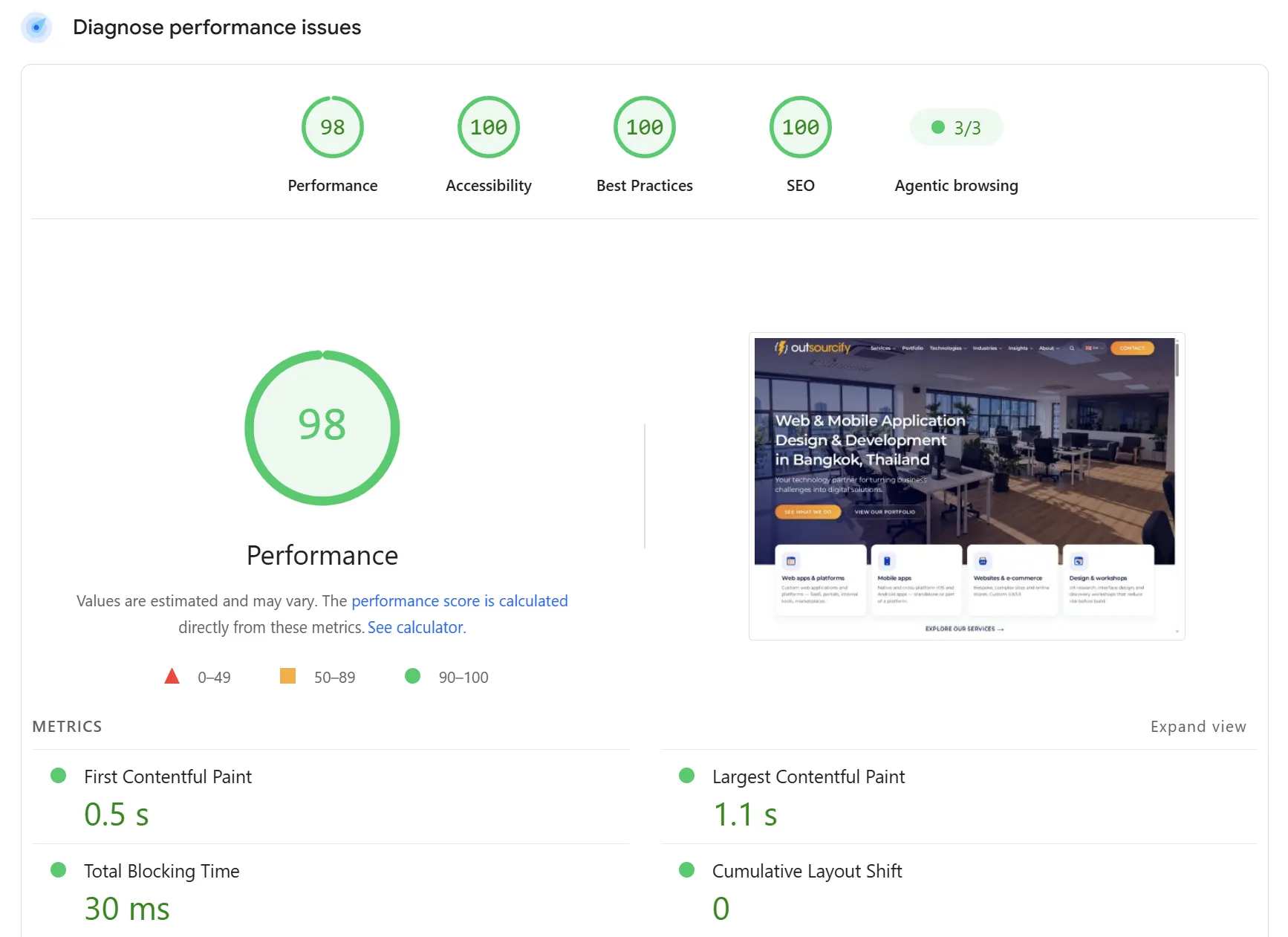
“Faster” isn’t just a feeling — here’s where the homepage lands on a fresh audit:
Everything that made the old site useful is still here — 88 case studies across banking, aviation, e-commerce, travel and NGO work, dozens of guides and articles, a full team page, and the client reviews that back it all up. It’s just running on infrastructure we’re not afraid to keep changing.
No CMS, and that’s fine — we’re developers
One trade-off we made deliberately: outsourcify.net doesn’t have a CMS anymore. There’s no WordPress dashboard to log into, no “add new post” button, no plugin update to worry about at 2am. Every case study, every article, every price change goes through the same Git-based workflow we use for actual code — a file gets edited, reviewed, and merged.
For us, that’s a feature, not a limitation. We’re a software company; reviewing a content change like a pull request is more natural to us than clicking through an admin screen, and it comes with things WordPress never gave us for free — full history on every edit, the ability to preview a change before it goes live, and zero risk of a plugin update taking the site down.
It’s also not what we’d hand a non-technical client. If you don’t want your marketing team editing content through pull requests, that’s a completely reasonable position — and it’s exactly why this is a service, not a one-size-fits-all opinion. We build the same architecture — static, fast, Astro-based — with a proper CMS layered on top, so your team edits content the way they’re used to while the site underneath stays just as fast and just as maintainable. Losing the CMS was the right call for us. It doesn’t have to be the right call for you.
We’d rather you see for yourself
Browse enough agency websites and a pattern shows up fast: a vague “our team” section with stock photography, no names beyond maybe a founder’s LinkedIn buried in the footer, and a portfolio of four polished logos that tells you nothing about what was actually built. We think that’s backwards for a business you’re about to trust with your product.
So the new site keeps doing what the old one did, only more of it. Every one of our 34 team members has a real profile — photo, role, background — including Kwan and Benoit, our founders, who show up on the team page the same as everyone else rather than tucked away in an “our story” paragraph. If you want to know who would actually work on your project before you talk to us, that page is built to answer it.
The same thinking shaped the portfolio. A lot of agencies show a handful of their best-looking projects and leave it there. We’d rather show as many as we reasonably can — 88 case studies at last count, across banking, aviation, travel, NGOs, e-commerce and more. And to be honest about the limits of that: it’s still not everything. Some of our work — for government bodies, financial institutions, humanitarian organizations — comes with contractual confidentiality that means we can’t name the client, and sometimes can’t publish the project at all. Where we can, we describe the problem and the build without naming who it was for, rather than pretending the work didn’t happen. What’s public is real work with real detail, not a highlight reel.
Built to be understood by machines, too
One more thing we paid attention to this time: how AI systems read and represent us, not just how people browse the site. Our old site apparently did something right on that front already — we regularly show up in answers from AI assistants when people ask about agencies that do this kind of work, which we take as a sign that having real, structured information about who we are and what we’ve built was already useful to models, not just to visitors.
We leaned into that deliberately with the rebuild. The content is structured rather than buried in shortcodes and page-builder markup, the facts are the actual facts rather than marketing copy dressed up as facts, and the team and project pages that answer “who is this company and what have they done” for a human are built to answer the same question just as clearly for an AI. We can’t control what any given model decides to say about us — but we’d like whichever one gets asked to have the full, accurate picture available when it looks.
We didn’t build this blind
This wasn’t a leap of faith — it’s the same migration approach we now offer clients who are in the position we used to be in. We used outsourcify.net itself as the proving ground: a real, decade-old WordPress site with real content debt, migrated with the same discovery-first, verify-before-you-cut-over process we’d use on any client project.
If you’re curious what that actually looked like in practice — the rollback plan, the export tooling, the parity checks before a single Astro page got built — we wrote it up in detail: WordPress to Astro: how we migrate a site properly.
And if your own WordPress site is starting to feel like ours did, get in touch — this is now something we do for clients, not just for ourselves.