


ERP for a Jewelry Manufacturer
Recipes, metal-rate pricing, production vouchers and AI visual search on Symfony / API Platform
Visit websiteExpertise
 Web applications
Client

Maneekan Siam (Thailand)
Client testimonial
The Outsourcify team is very professionnal. Much better than most of the other local developers I had to work with. We are still working with them and we will continue. I highly recommend them.

See all testimonialsThe Outsourcify team is very professionnal. Much better than most of the other local developers I had to work with. We are still working with them and we will continue. I highly recommend them.
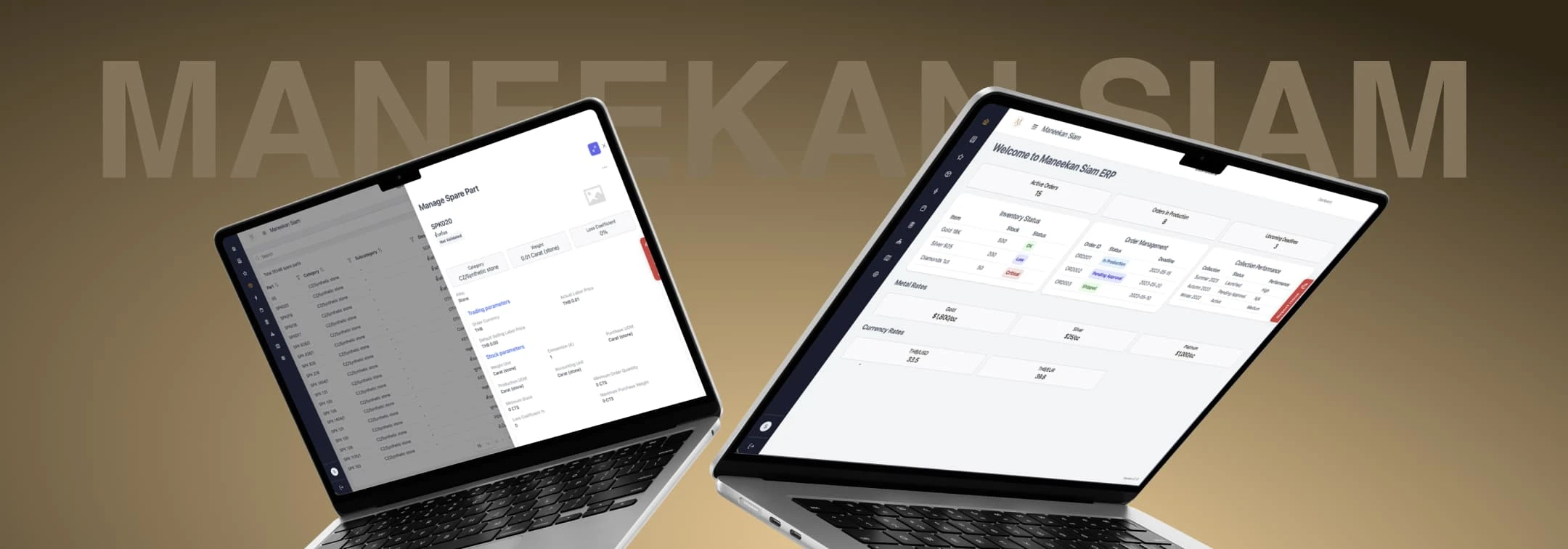
Maneekan Siam is a premier handcrafted jewelry manufacturer based in Bangkok. Their operations ran on a fragmented legacy setup of Microsoft Access tools — one for sales and client directories, another for stock, production and vouchers. Outsourcify engineered a bespoke ERP that consolidates CRM, jewelry recipe and pricing engines, real-time metal stock tracking, physical factory production vouchers and multi-currency accounting controls into a unified intranet ecosystem deployed on-premise inside the factory.
Results
Challenge
Jewelry manufacturing combines volatile economics with a very physical workflow. Suppliers quote in multiple currencies, gold and silver rates move daily, and the true cost of a piece depends on metal weight, alloy purity and labor markups buried in production data. On the floor, batches of jewelry physically travel between factory sections with paper vouchers, so the software had to strengthen — not replace — the signed chain of custody. For reliability, the client also required an on-premise production deployment on their private local intranet, with manual deployment pipelines favored over automated CI/CD to keep corporate control air-gapped.
Solution
We built a decoupled, API-driven platform: a Symfony backend with Doctrine ORM and API Platform generating secure REST endpoints, protected by JWT signatures and role-based access control, with a Vue.js / Nuxt single-page application on the front. Production runs on-premise on the factory intranet, with staging hosted on DigitalOcean and Sentry error monitoring. A spare parts and stones database feeds product recipes that specify the exact raw materials, labor steps and plating micron layers for each piece, while a pricing engine converts recorded bank exchange rates and precious metal indices into live THB-per-gram costs for gold, silver, rhodium and palladium. Purchase orders spawn automatically when stock falls below minimum order quantities, capture real landed costs on receipt, and spread bank charges, transport and customs across received items through a cost-spreading algorithm — with PO splitting to handle partial shipments. Digital stock cards log every movement, and material handovers require selecting a destination factory section and an assigned worker before a printable signed slip is generated. Production vouchers route each batch across Casting, Setting, Polishing, Plating and Quality Control with bulk transfer screens and A4 handover PDFs, while order modifications trigger dependency checks that lock affected vouchers until floor managers resolve them. On top, AI features run locally: an Ollama-served LLM and a Qdrant-powered visual search across tens of thousands of indexed product photos.
Tools
Symfony, API Platform, Doctrine ORM, Vue.js / Nuxt, JWT & RBAC, Ollama, Qdrant, Sentry
Tools
Symfony, API Platform, Doctrine ORM, Vue.js / Nuxt, JWT & RBAC, Ollama, Qdrant, Sentry




Product & recipe management
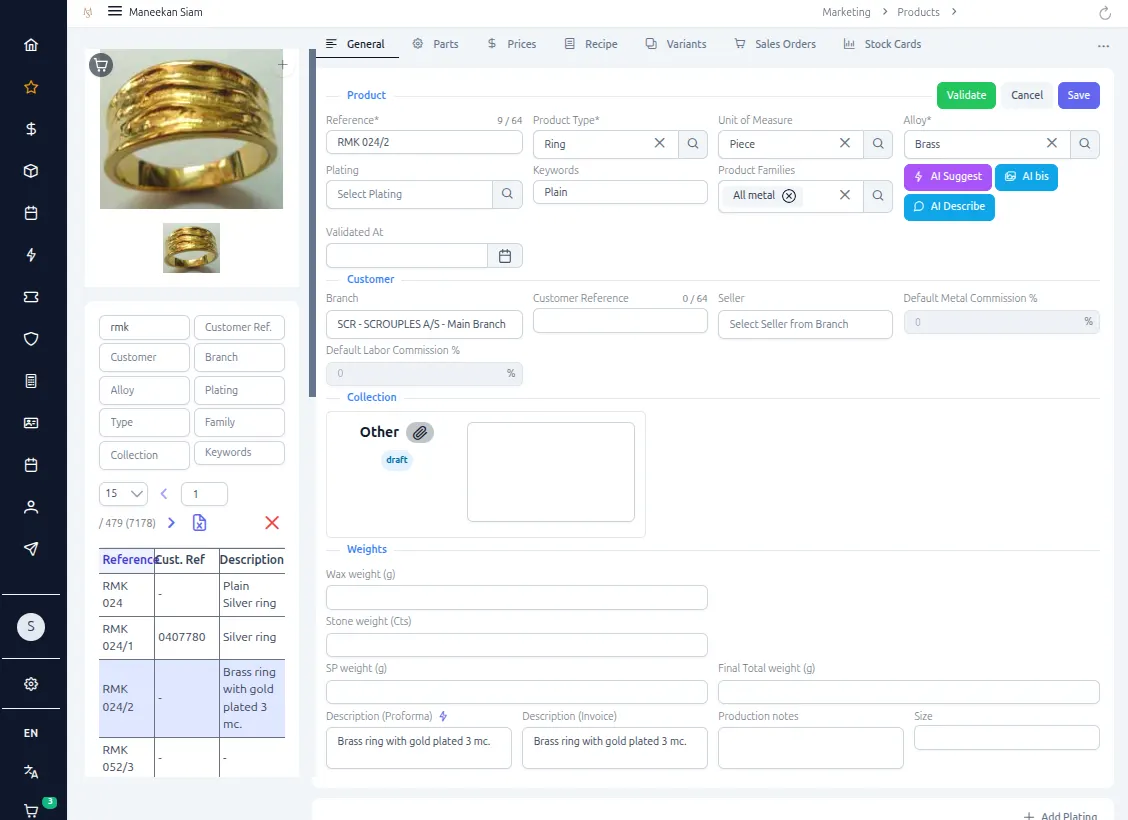
Every finished piece in the catalog — 8,714 products and counting — is bound to a production process recipe specifying exactly which raw materials, labor steps and plating thicknesses it requires. A spare parts and stones database underneath tracks metals, gemstones, pearls and diamonds with detailed dimensions, cuts, quality grades and warehouse quantities. Operators flip fluidly between product views, upload images by drag-and-drop or straight from the clipboard, and rely on image-matching routines that flag duplicate patterns against the company's naming conventions. Cart selections export to XLSX sheets alongside ZIP archives of product images, and production costs recalculate automatically from metal weight, alloy purity, current market rates and supplier labor markups.
Production planning across factory sections
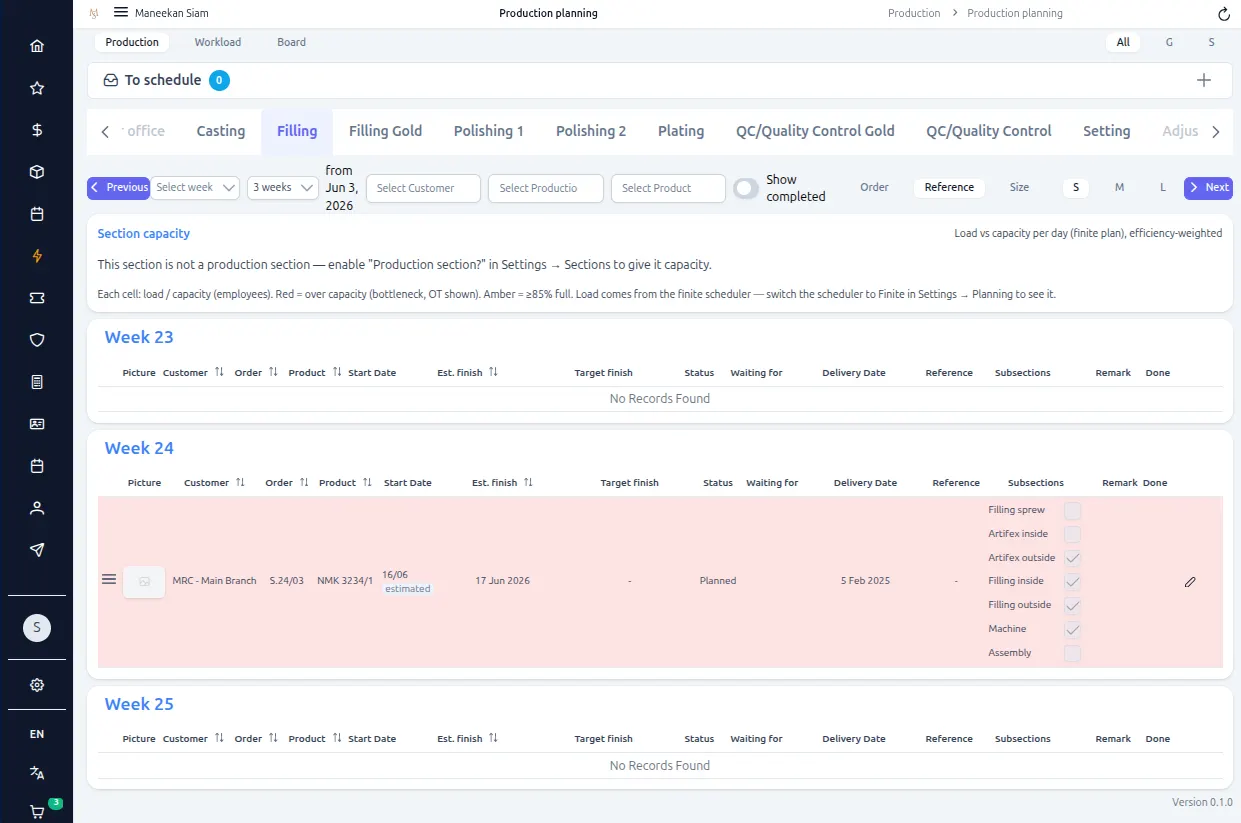
When a sales order is released to the factory, the ERP generates physical production vouchers that travel with each batch across the plant's sections — Casting, Setting, Polishing, Plating and Quality Control. A planning board shows supervisors where every voucher sits, and a dedicated transfer screen lets them move vouchers in bulk to the next section or back into semi-finished stock, printing an A4 handover list with signature rows to preserve the physical chain of custody. If a client modifies or cancels an order already in production, the system runs a dependency check, flags the affected vouchers on the factory dashboards and locks the order until floor managers resolve, split or merge them.
Live currency & precious metal rates
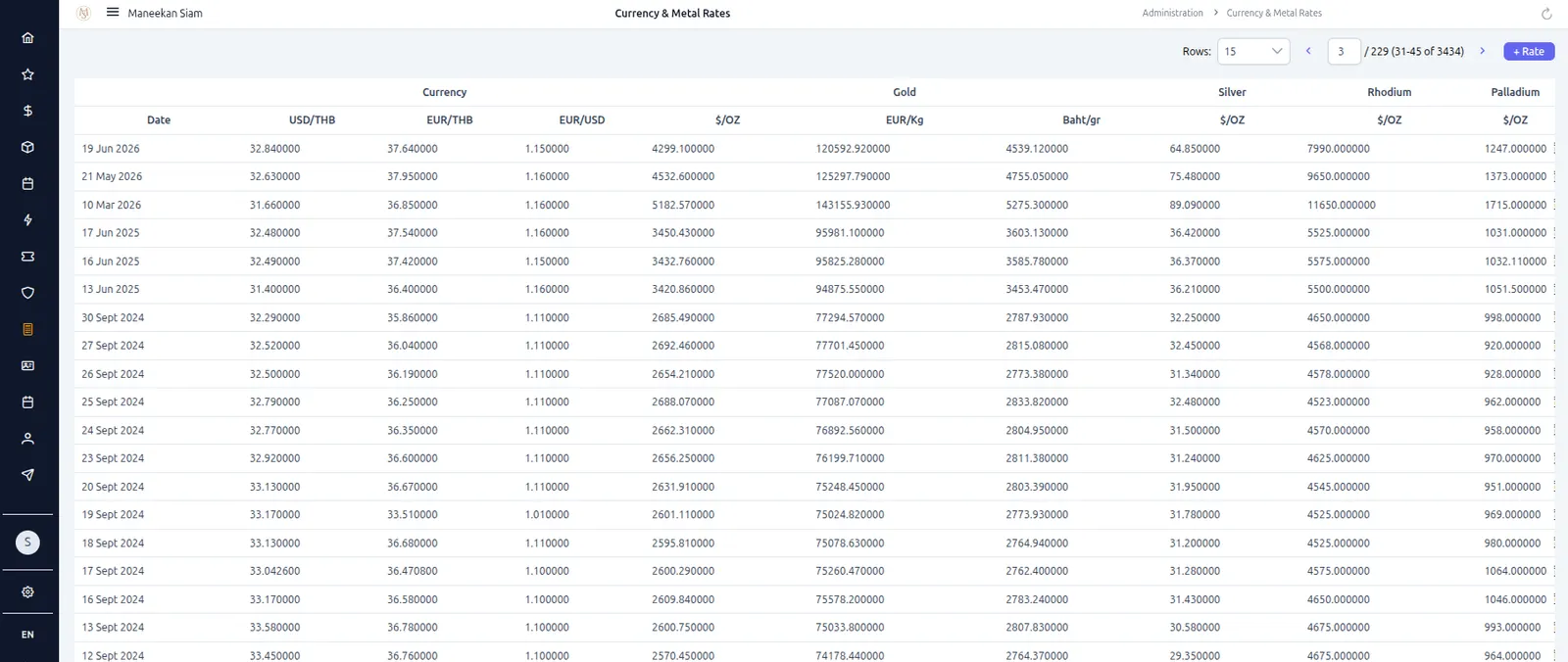
A rates board records official bank exchange rates (USD/THB, EUR/THB) alongside global precious metal indices such as the London Fix — 3,434 rates recorded to date. From these entries the system automatically maintains live THB-per-gram conversion rates for gold, silver, rhodium and palladium, so every product's production cost tracks the market. Because material prices move daily, this engine is what keeps quotations honest: costs recalculate from metal weight, alloy purity and current rates instead of stale spreadsheet figures, factoring in supplier labor markups on top.
Purchase receipts with cost spreading
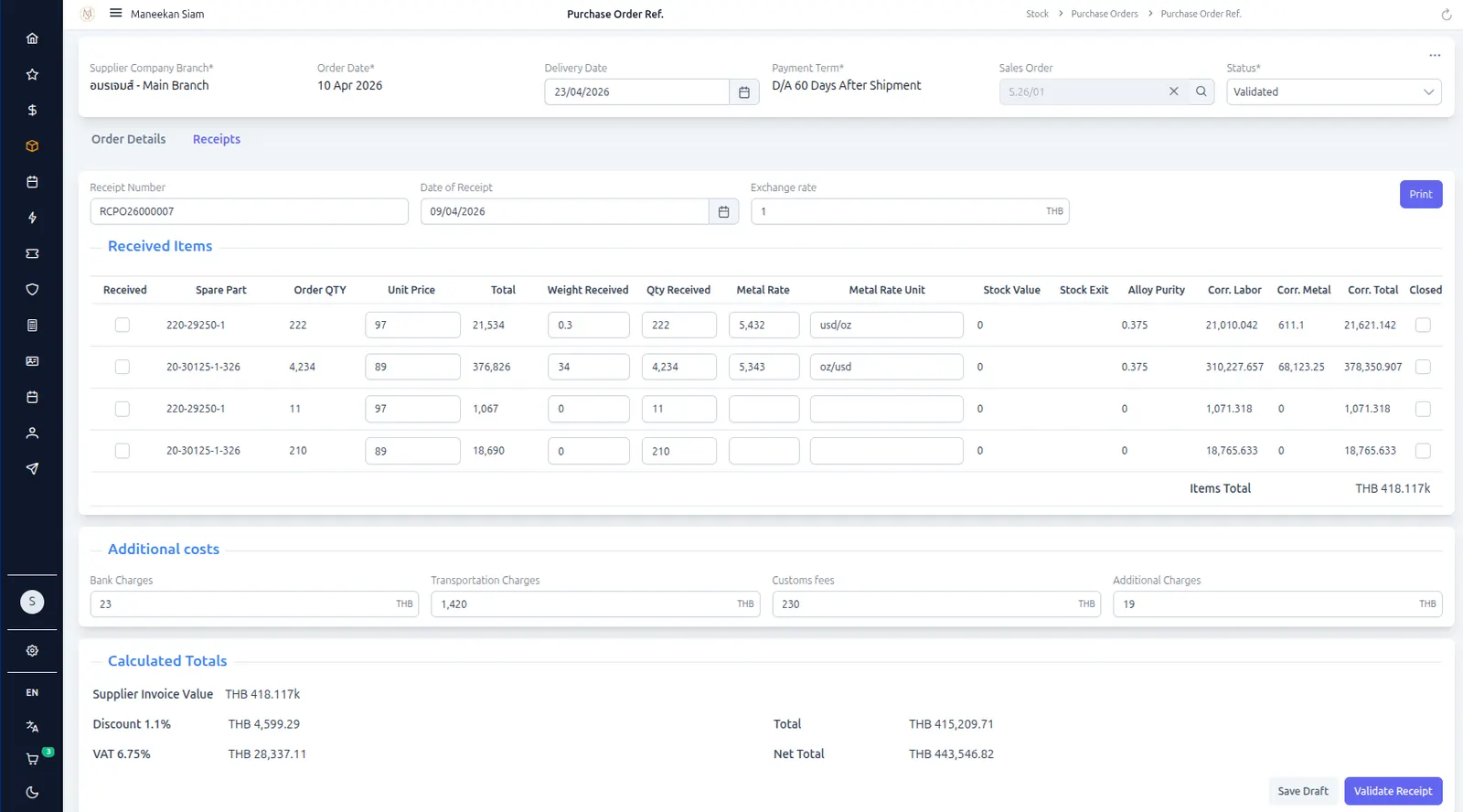
Draft purchase orders spawn automatically when inventory falls below defined minimum order quantities. When goods arrive, a dedicated receipts view captures the real landed costs — shipping, bank charges, customs import tariffs, insurance and exchange-rate variations — under unique receipt numbers. A cost-spreading algorithm then distributes these overheads across the received items to produce corrected labor, metal and total prices. Partial shipments are handled too: a single PO can be split into two documents, with a new PO created for the remaining line items while original price benchmarks are preserved. Digital stock cards log every movement with running balances per warehouse and section, with batch PDF export for printed records.
AI-powered visual search & cataloging
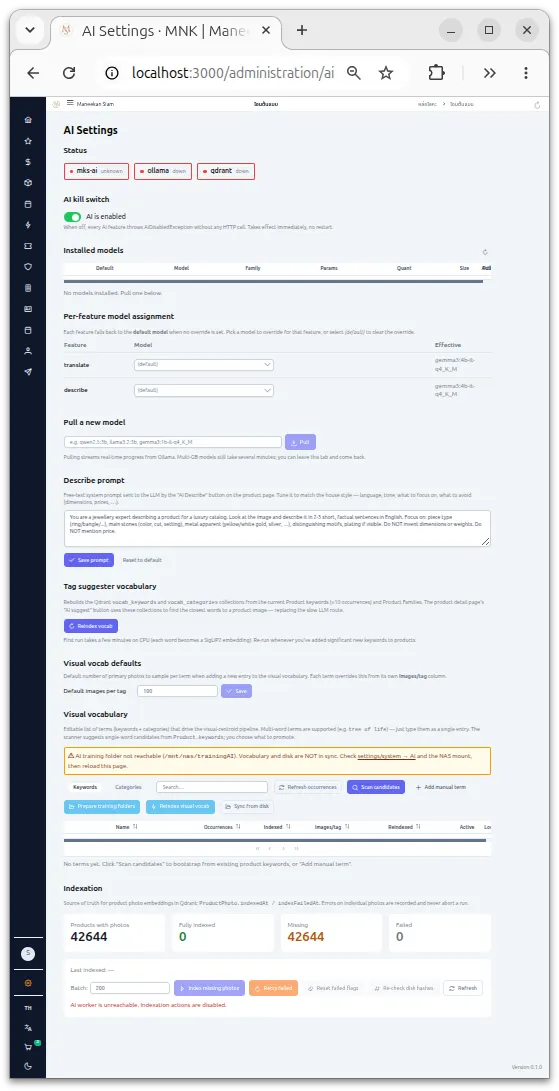
The ERP embeds AI features that run entirely on the client's own infrastructure: a local large language model served through Ollama and a Qdrant vector database powering visual search, with 42,644 product photos indexed. Staff can find a design from a photo rather than a reference number — invaluable when a catalog spans thousands of handcrafted pieces and near-duplicate patterns. Keeping inference local matches the company's on-premise deployment philosophy: the production system runs on a private factory intranet with manual deployment pipelines, so product imagery and commercial data stay in-house.
Where this project sits in our history
- 2018
 Labtech Engineering Co., Ltd.LabTech Engineering
 - 2019
 JF Network (Germany)B2B e-commerce for automotive parts
 - 2020
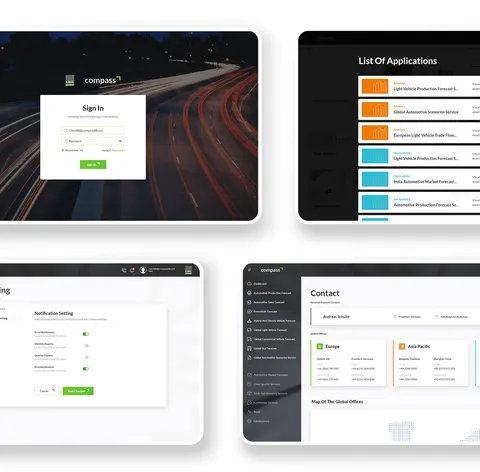 LMC Automotive (United Kingdom)Business Intelligence Qlik Sense UI
  2020Foil SportsB2B online orders 'Best Fit' system
 2020Next Industry (Thailand)Web & Mobile Application UX/UI
- 2023
 Tropfin (Thailand) Co., Ltd.B2B Trading Platform for the Canned Food Industry
  2023Empower SteelA leading steel manufacturing company
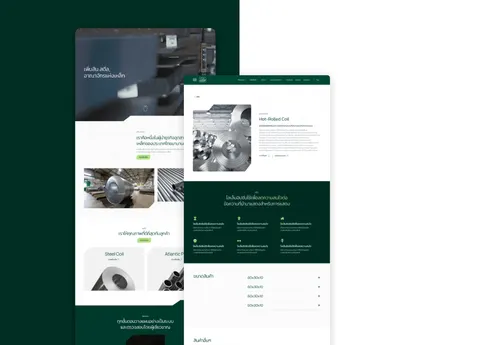 2023Permsin Steel WorksSteel Fabrication Expertise Website
- 2025
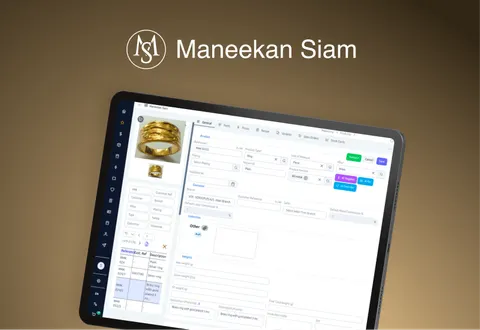 Maneekan Siam (Thailand)ERP for a Jewelry ManufacturerYou are here
Contact us
Let’s find the right solution for your business.
We partner with product teams and founders to design, build, and ship software that lasts.
Talk to our team