Whether you’re building a web application, mobile app, or backend system, understanding how the tools and frameworks you depend on evolve over time is essential. Software versioning and roadmap strategies aren’t just technical details — they directly affect your team’s ability to plan upgrades, manage dependencies, and deliver stable products.
In this article, we’ll explain how software versioning works, why it matters, and how popular open-source projects like Symfony, Node.js, and React Native handle versioning and long-term planning. You’ll get a clearer picture of what to expect from each platform, helping you plan development more effectively.
What Is Semantic Versioning?
Most modern projects, including Symfony, Node.js, and React Native, follow semantic versioning (Semver). The format is simple: MAJOR.MINOR.PATCH (e.g., 7.0.3), and it tells you at a glance what kind of changes to expect.
- MAJOR: Breaking changes. Updating may require rewriting parts of your code.
- MINOR: New features, no breaking changes.
- PATCH: Bug fixes, performance improvements, and small updates.
Let’s now look at how each of our selected frameworks handles versioning and roadmaps in practice.
Symfony: A Predictable, Enterprise-Friendly Roadmap
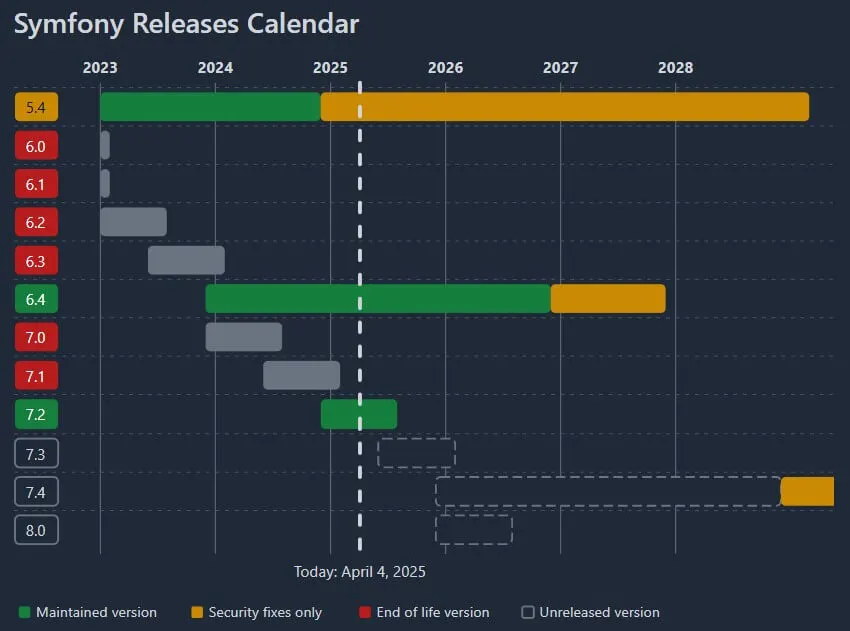
Symfony is known for its predictable release cycle and strong commitment to backward compatibility. Every major version comes out every two years, always in November of odd-numbered years. Minor versions are released twice a year (May and November), and patches monthly.
Key highlights:
- LTS (Long-Term Support) releases (such as 7.4) offer extended bug and security support.
- Standard releases are supported for 8 months.
- Major versions remove deprecated features from the previous cycle.
- You can upgrade to the latest minor version (e.g. 6.4), fix all deprecations, then move to the major (7.0) confidently.
Symfony’s roadmap and strict versioning make it especially appealing for long-term, stable enterprise projects.
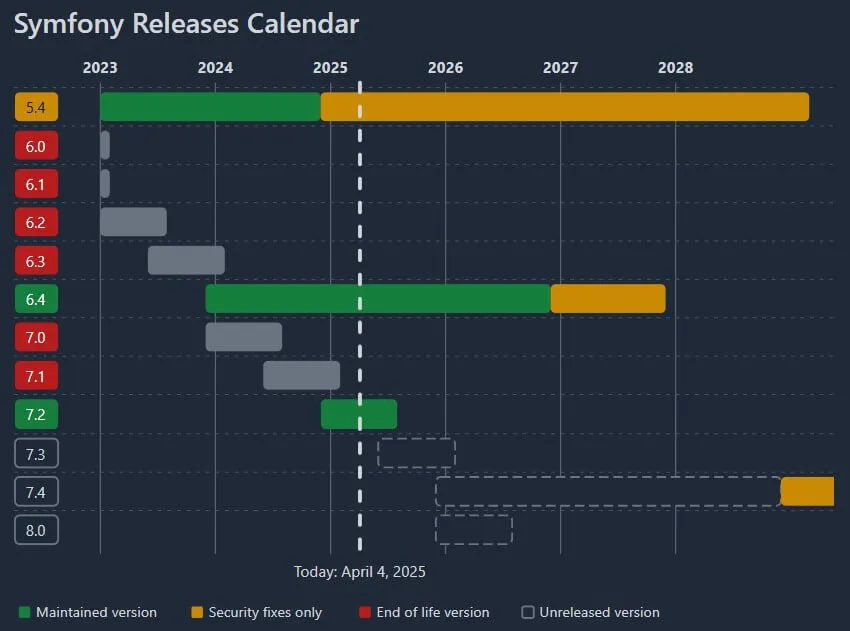
symfony roadmap
Node.js: Dual Release Channels and LTS Support
Node.js also follows Semver but introduces a different strategy by using two parallel release channels:
- Current: Updated frequently with the latest features.
- LTS (Long-Term Support): Focused on stability, with support lasting for 30 months.
Node.js is transitioning its release schedule. Up to Node.js 26, new major versions entered a six-month Current phase, with selected versions moving to LTS. Starting with Node.js 27, the project is moving to an annual major-release cycle in which each major is intended to progress toward LTS. Production applications should use an Active LTS or Maintenance LTS release and verify support dates on the official release page.
This clear lifecycle helps developers and DevOps teams manage upgrade cycles with minimal risk.
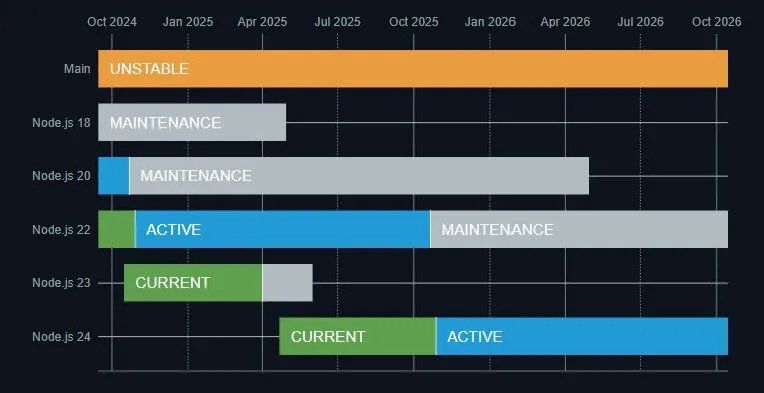
node roadmap
React Native: More Frequent Releases, But Stable Channels Too
React Native has a faster-moving release cycle and is developed by Meta, with community input. The project currently targets a new minor version about every two months, following a release-candidate process before promotion to stable.
Despite more than a decade of development, React Native remains on a 0.x version line. Version 0.86 is the latest stable release as of July 2026. The absence of a 1.0 label has not prevented widespread production adoption, but the fast support cycle makes regular upgrade planning especially important.
However, due to the mobile ecosystem’s complexity, the community and Meta introduced the React Native Release Channel strategy:
- Latest: Contains the newest features.
- Stable (via Expo SDK): For developers using Expo, stable SDKs bundle a vetted React Native version every few months.
- React Native Reanimated, Hermes, and other dependencies: Often versioned independently, which complicates upgrades.
Since React Native doesn’t have official LTS versions, long-term stability is community-driven. Larger projects often pin to specific versions and upgrade less frequently to avoid breakage.
Despite a lack of formal LTS, tools like react-native-upgrade-helper and changelogs help developers navigate breaking changes.
Implementing Software Versioning with GitHub at Outsourcify
Versioning is essential for all software, including the solutions we develop at Outsourcify, as it facilitates tracking changes, managing dependencies, and ensuring compatibility. By assigning unique version identifiers to each release, we can monitor the evolution of our software, making it easier to identify and address issues, collaborate effectively, and maintain a clear history of modifications. This practice not only aids in debugging and enhancing features but also provides transparency to our clients regarding the updates and improvements made over time.
At Outsourcify, we employ a structured approach to software versioning using GitHub, ensuring clarity, consistency, and efficiency across our development projects. This methodology encompasses several key steps:
- Feature Branching: Each new feature or bug fix is developed in its own branch, facilitating isolated changes and simplifying integration.
- Semantic Versioning: We follow semantic versioning principles—assigning version numbers in the format of MAJOR.MINOR.PATCH—to clearly communicate the nature of changes.
- Pull Requests and Code Reviews: Before merging into the main branch, all code undergoes rigorous peer reviews through GitHub’s pull request system, ensuring high-quality standards and collective code ownership.
- Continuous Integration and Deployment (CI/CD): Automated pipelines are triggered upon merging pull requests, running tests and deploying changes to staging or production environments as appropriate.
- Release Management: Upon finalizing a set of features or fixes, we create a new release on GitHub. This involves tagging the repository with the new version number and generating release notes that summarize the changes.
- Monitoring and Feedback: Post-release, we monitor the application for any issues and gather user feedback to inform future development cycles.
This disciplined approach enhances collaboration, streamlines the deployment process, and allows us to deliver reliable and maintainable software solutions to our clients.
Why Versioning and Roadmaps Matter
Understanding how software evolves helps:
- Avoid surprises in production.
- Plan upgrades based on LTS cycles.
- Reduce technical debt by proactively handling deprecations.
- Improve security by staying on supported versions.
It also helps teams align their own product roadmap with the technologies they use. For example, if you’re building a mobile app with React Native, knowing when a new version drops (and what it breaks) lets you plan sprints accordingly.
Frequently Asked Questions
What does a semantic version number mean?
Semantic versioning uses MAJOR.MINOR.PATCH. A major change may break compatibility, a minor release adds backward-compatible functionality, and a patch release contains backward-compatible fixes. Projects may add prerelease labels or follow additional lifecycle rules.
What is an LTS software release?
An LTS, or Long-Term Support, release receives fixes for a longer published period than a standard release. It is often the safer choice for production systems, but teams must still monitor the exact security-support end date for every dependency.
When should a production application upgrade a dependency?
Plan an upgrade before the installed version reaches end of support. Review release notes and deprecations, test the upgrade in a representative environment, update dependent packages, run automated and manual regression tests, and prepare a rollback strategy before production deployment.
Is the newest software version always the best choice?
Not necessarily. A Current or newly released version may provide useful features, while an established LTS release may offer a more predictable support window. The right choice depends on security, compatibility, product requirements, team capacity and the cost of future upgrades.
Wrapping Up
At Outsourcify, we often help clients navigate technology choices — and one of the most overlooked aspects is versioning. Whether it’s Symfony’s enterprise-grade stability, Node.js’s dual-track system, or React Native’s rapid evolution, having clarity on versioning helps future-proof your project.